
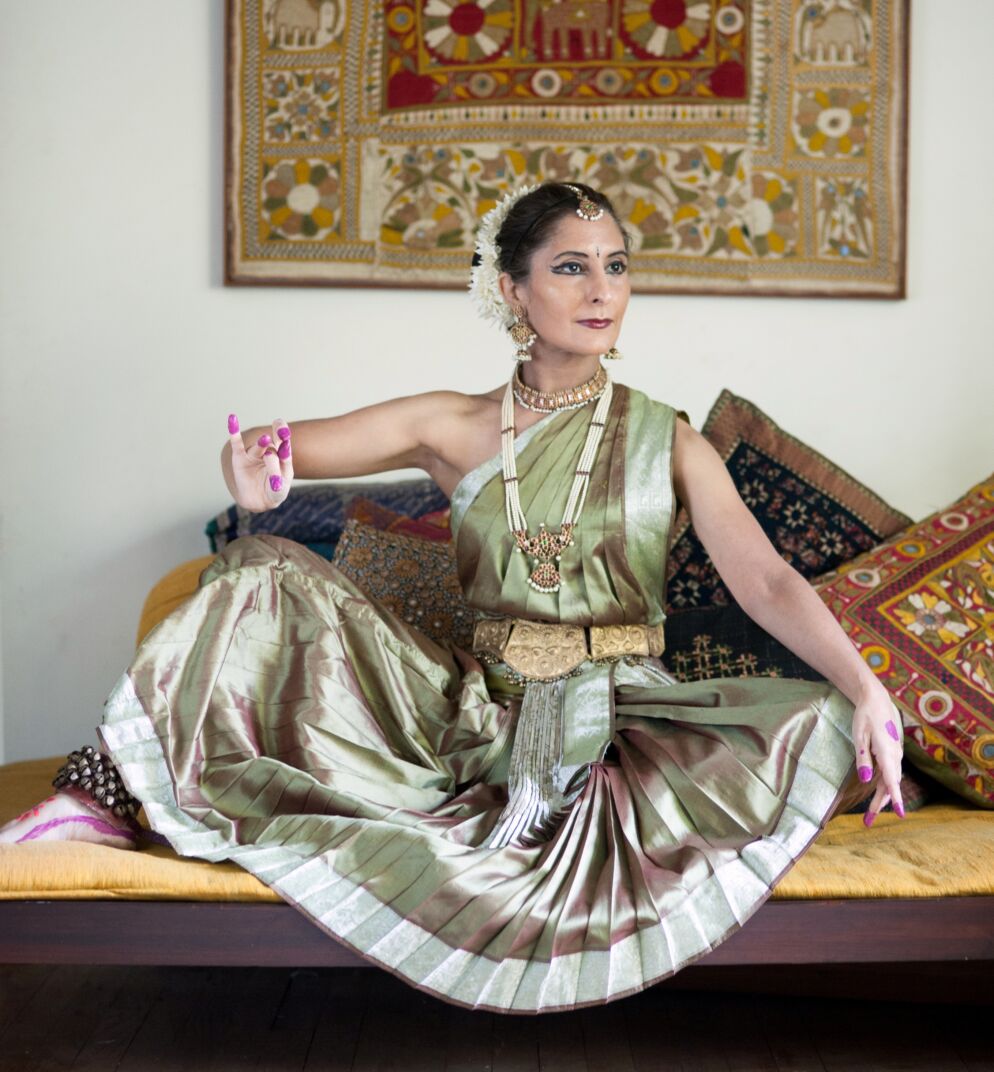
The Kuchipudi classical Indian dance form is filled with gestural flourishes and flat-footed rhythmic components that serve as the driving force in this elegant storytelling dance drama. Silver Spring resident Nilimma Devi has been a master teacher and practitioner of Kuchipudi for more than six decades.
Yet, when she dances or choreographs, her works are not museum pieces for preserving a 1,000-year-old dance. Devi, and now her daughter, Anila Kumari, craft dances that uphold Kuchipudi’s long history in northern India and its deep roots in Hindu myths and practices.
In fact, many of these dance dramas play out as love songs to the god Krishna or depictions of other Indian saintly figures. Kuchipudi also draws from the “Natya Shashtra,” a Sanskrit treatise on the arts written in verse, that features hymns of praise for the deity Shiva, as well as discussions of aesthetics, self-improvement and the essential art forms.
Devi, speaking from her living room filled with art, sculptures and figurines from India, Africa and Asia, described how this dance form was for men only in its beginnings. “My early guru was Dr. Nataraja Ramakrishna,” she said. “His students were mainly young men, but there were some girls. He rediscovered one of the dances of the Middle Ages in India. They used the dance to infuse courage and infinity of soul … it was a very vigorous.” Like an archaeologist, he reconstructed the dance from historic texts and murals depicting the men preparing for battle.
Today, Devi noted, Kuchipudi, particularly as practiced and taught in North America, has become dominated by women.

Life Across Borders
Born in prepartition Pakistan, while the Indian subcontinent was under British colonial rule, Devi, like many American emigres, has lived a life filled with border crossings. The daughter of a diplomat, she remembers her first guru or teacher was her aunt and her debut dance performance took place for an Indian independence day celebration in Kabul, Afghanistan, when she was a child.
As she matured, Devi sought further study in south India, recalling, “What was happening [was] people were going back to old cultures and taking the folk and the cultural dances and then putting them on stage.” Today that occurs frequently, but then it was an innovation. From her various gurus Devi perfected Kuchipudi’s classic technique, which demands about a decade of serious effort, similar to what it takes to become proficient at ballet. Kuchipudi is known for specific hand gestures called mudras, akin to a sign language that illustrates the storytelling dances without spoken dialogue.
Devi arrived in Montgomery County after she married an American scholar studying Indian history. By then she had children and had been teaching both Indian aesthetics and dance. Building a home and family in the county allowed her to forge ahead and start her own school and company to instruct and create dances.
Today, part of Devi’s home is devoted to the Sutradhar Institute of Dance and Related Arts. There, in the paneled basement studio, decorated with artist-made masks, wall hangings and drums from India and beyond, she, her daughter and now granddaughter, Riya Devi-Ashby, all teach and choreograph Indian dance and allied art forms, including poetry, storytelling, art and the martial art form Thang-Ta. Founded in 1988 as Devi Dance Theater, now known as Sutradhar Dance Company, it continues to present new performances that draw from both the classical Kuchipudi technique and contemporary movement styles and thematic ideas.
Dora Slane, who grew up in Silver Spring, attended Sutradhar’s Kuchipudi classes as a girl. Now a kindergarten teacher and mother, she found her way back to the studio. “My grandfather was a huge poetry lover,” she said. “I found a way to connect with him [here] through the poetry and dance.” She continued, “Now my body is bringing me back. I feel deeply in my muscles and bones that I’ve come home. This [studio] is so rooted in me; it’s giving me back my sense of self and connecting me to my heritage.”
Collaborating Across Borders
The company often seeks out collaborators from other dance styles. Sutradhar Dance Company has worked with Coyaba (African) Dance Theater, Somapa Thai Dance Company, modern dancer Daniel Burkholder, Iranian composer Ahmed Bohrani, and gospel singer Ayaba Bey, expanding the footprint of Indian dance.
The educational component of Sutradhar’s nonprofit institute offers classes for children as young as four through adults of all ages in Kuchipudi, along with vinyasa yoga, Thang-Ta, storytelling, and arts and crafts. In the summer, Kumari leads a day camp for children focusing on Indian art forms and their intersection with issues and ideas kids and teens deal with, like bullying or self-image and eating disorders.
Finding Female Power in Poetry
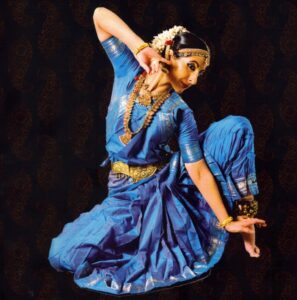
The company’s newest work, “Yogini: Battle for Peace,” which means an awakening of the consciousness, draws on both classical Kuchipudi structures and contemporary processes of collaboration. It will premiere May 23 at the Black Box Theatre in downtown Silver Spring.
The work for an all-female cast is inspired by Kumari’s own poetry, where she invokes a 2,000-year-old Sanskrit poem that asks an existential question from the Upanishads — a Psalm-like collection of spiritual hymns — “Who am I? I am my soul, not my body.”
“This is a journey for Anila,” Devi said, as she observed her daughter in her choreographic element. The work, like all Sutradhar pieces, balances ancient and modern. In “Yogini: Battle for Peace” the women dance to reflect the 64 goddesses, or yoginis, carved into temples across India, who, in Hindu texts, are meant to defeat a demon.
These ancient mythological figures got Kumari thinking about divine feminine power today. “Some people think that a yogini is a witch. … Others see them as those who retreated to caves and solitude to pursue this inner work of ‘Who am I?’” Kumari reflected: “‘Am I a woman only because I married, had children?’ In the work we are exploring not only identity, but caretaking. Do we have an obligation to our earth? … This is about women who were deep thinking but not simply armchair activists or armchair philosophers. These women felt a deeper connection to the world than those in the society.” That process allowed her to look at yogini as inspiration for 21st-century audiences.
Devi-Ashby, Kumari’s daughter, dances and makes art. For “Yogini: Battle for Peace” she designed and built masks for the goddess-like dancers and the demon character. And this third-generation Kuchipudi dancer observes growth and evolution in the dance she learned from her grandmother and mother. “I want people to know it’s a contemporary dance form also,” she said.
“Yogini means a human being who is strengthening the mind in order to take action, to care for their community, their families, and their gardens,” Kumari said. Some of the great poets of India were considered radicals, she noted, adding that today, too, should be a period of radical reflection and action. Kumari hopes “Yogini: Battle for Peace” will provoke its audience to instigate the changes society needs.
“The best of the [Kuchipudi dance] technique is taught here. It’s preserved here. It’s perpetuated here,” Devi, whose name means goddess, said. “But we don’t allow it to sit in a corner. It must cross over to serve people. That’s why art exists. We are here to serve everybody. They should all gain something wonderful from it.”
“Yogini: Battle for Peace” will be presented May 23 at 6 p.m. at the Silver Spring Black Box Theatre, 8641 Colesville Rd. Tickets: $25-$15 (for children). Visit dancesidra.org/events.html for information and tickets.