
Chevy Chase resident Dasha Pomeranz fell in love with classic mid-20th-century dresses when her grandfather gifted her a set of cards depicting fashionably dressed women from the 1950s. Growing up in Moscow, she recalls, “My sister, Masha, and I were influenced by our grandmothers, who were talented seamstresses in the 1950s and ’60s. We grew up with the sound of an old Singer sewing machine. That sound first inspired in us a love of fabric and fashion.”
“All my childhood, I wanted to be a designer,” Pomeranz says. “I would sketch dresses, but I never, ever thought that I could become [a designer]. In the post-Soviet Union Russia, [parents] expected their kids to be either a doctor or an economist.”
But, Pomeranz’s dream ultimately came true, although her path has been circuitous — not unlike that of so many immigrants across the decades, who leave their birthplace to find freedom, safety, education, stability in new lands.
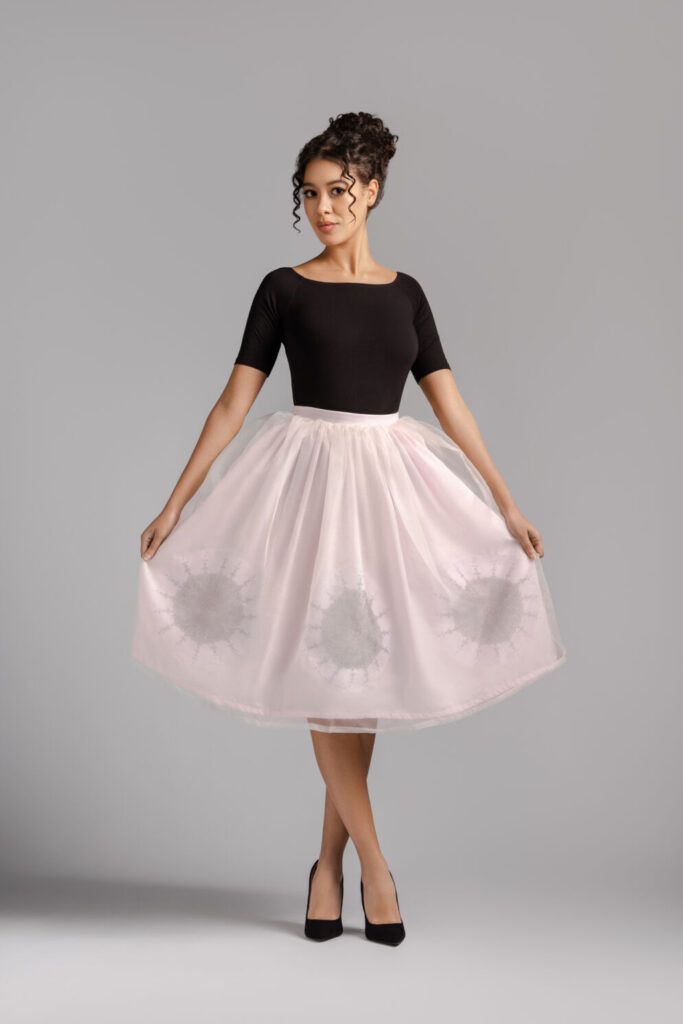
A one-time journalist in Moscow, she opened that city’s first vintage shop after wandering into a London vintage store and falling in love with the clothes. Without being able to sew herself, the two sisters opened a bespoke dress company — the eponymous Mrs. Pomeranz — designing elegant, artful women’s dresses evocative of the 1950s with full skirts and fitted bodices or shirt waists, clean lines and a feminine aesthetic. The designs and fabric selections are theirs; presently seamstresses based in Latvia sew the custom dresses.
In her sunny first-floor home office, a clothing rack stands. It holds one-of-a-kind skirts and dresses fabricated from lace, brocade, silk, denim and patterned cottons embellished with embroideries, appliques, buttons, even domino tiles that represent the varied experiences and journeys women Pomeranz calls heroes have taken. These expertly sewn pieces would entice any fashionista who appreciates high-quality fabrics, perfectly aligned seams and hidden zippers.
Her shift to designing the skirts that reflect women’s immigration experiences hearkens back to childhood in Russia, that journalism degree and career in reporting and marketing, then successive moves to London and the United States. Pomeranz found her way to Montgomery County five years ago.
Recently, Pomeranz re-invented herself again, this time as an artist. “The Threads of Migration,” initiated in 2024, fuses journalism, fashion and art to tell often harrowing stories of immigrant women who have made their homes in Montgomery County and beyond.
“The fashion world was always lonely,” Pomeranz says. “I was searching for deeper meaning behind fashion. That’s why every dress in our fashion collection is named after a strong woman in culture,” dedicated to heroines and icons from books, films and popular media.
As an immigrant herself, Pomeranz connected to the many news stories she read about or heard covering challenges, legal and otherwise to immigrants in the U.S. in recent years. “I felt that I needed to respond to this situation,” she says.
The inaugural story she decided to focus on was Ella Kogan’s. “Ella was the first person whom I met when I relocated to Montgomery County,” Pomeranz says. Now 90, Kogan, a Soviet refusenik prohibited from leaving or practicing Judaism, ultimately settled in Maryland in 1987. Here she founded Shalom Education Center, among the first Jewish schools for Russian-speaking Jewish children teaching them what was prohibited in the Soviet Union. “Her stories are fascinating. I once spent three hours just listening to her describe how [the] KGB was chasing her.”
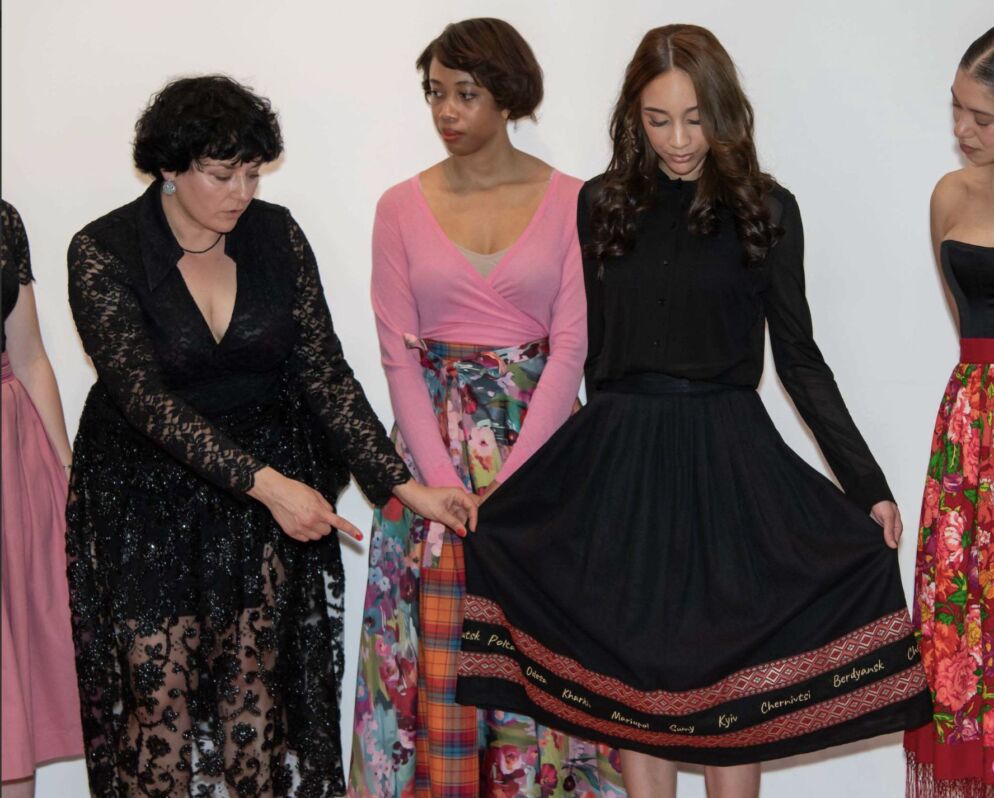
After the interview, Pomeranz took time to consider how to transform Kogan’s stories into a wearable art piece. She chose denim because of its value on the black market in the Soviet Union; and included a detachable cloth book — the Haggadah, used during the Passover seder, which she fabricated. “[Passover celebrates] the moment when Jews are trying to leave Egypt,” explains the artist. “These are the plagues of Egypt,” she points to a list in Hebrew and Russian, “because Soviet Jews were like Jews in Egypt; the Soviet government was like a pharaoh. They never let them go.”

Afghanistan-native Sughra Hussainy creates traditional Afghan arts, particularly intricate techniques in miniature painting. Now based in Maryland, in 2016 at 27, the Sackler Gallery of the Smithsonian Institution invited her to exhibit her Persian calligraphic works. The Taliban saw photos of her shaking hands with Barbara Bush, and on her return to Afghanistan, they threatened and chased her for traveling without a male escort and behaving as too emancipated as a woman.
Pomeranz reports that Hussainy described bringing a painting to school when she realized she was being followed by two bearded Taliban men in black. The painter was only able to avoid them by slipping into a crowd of women and children, where the men weren’t allowed to go. “She’s tiny but the toughest lady I’ve ever seen,” Pomeranz says.
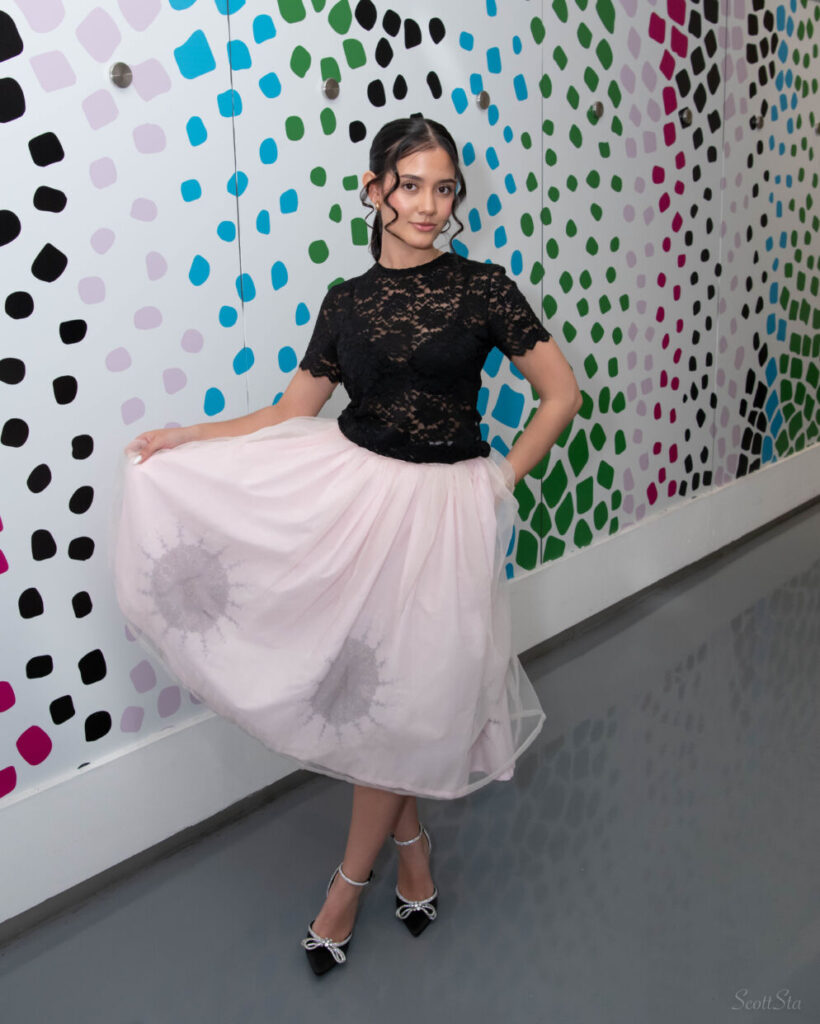
“I imagined her as a ballerina … like the dancer in ‘Swan Lake’ …. because she’s so fatigued, because the whole situation is so theatrical … so bizarre,” Pomeranz says. The gauzy skirt she designed uses a Hussainy painting near its border; the colors recall the variegated Afghani stones — lapis, ruby, emerald — commonly found in the nation’s mountainous region. “While this is not how I actually see Sughra — she’s very minimalistic, keeps everything in order — my skirts are not meant to be straightforward, and they’re definitely not cultural,” Pomeranz says.
Before she comes up with designs, following the interview, Pomeranz studies about each hero’s culture by reading nonfiction and fiction, viewing movies, listening to music and considering carefully how to tell a story of overcoming adversity in fashionable custom-made clothing. Each skirt is created in a model’s Size 2; a second one is made to fit the woman who inspired it. Additionally, those interested can purchase the unique design in their custom size.
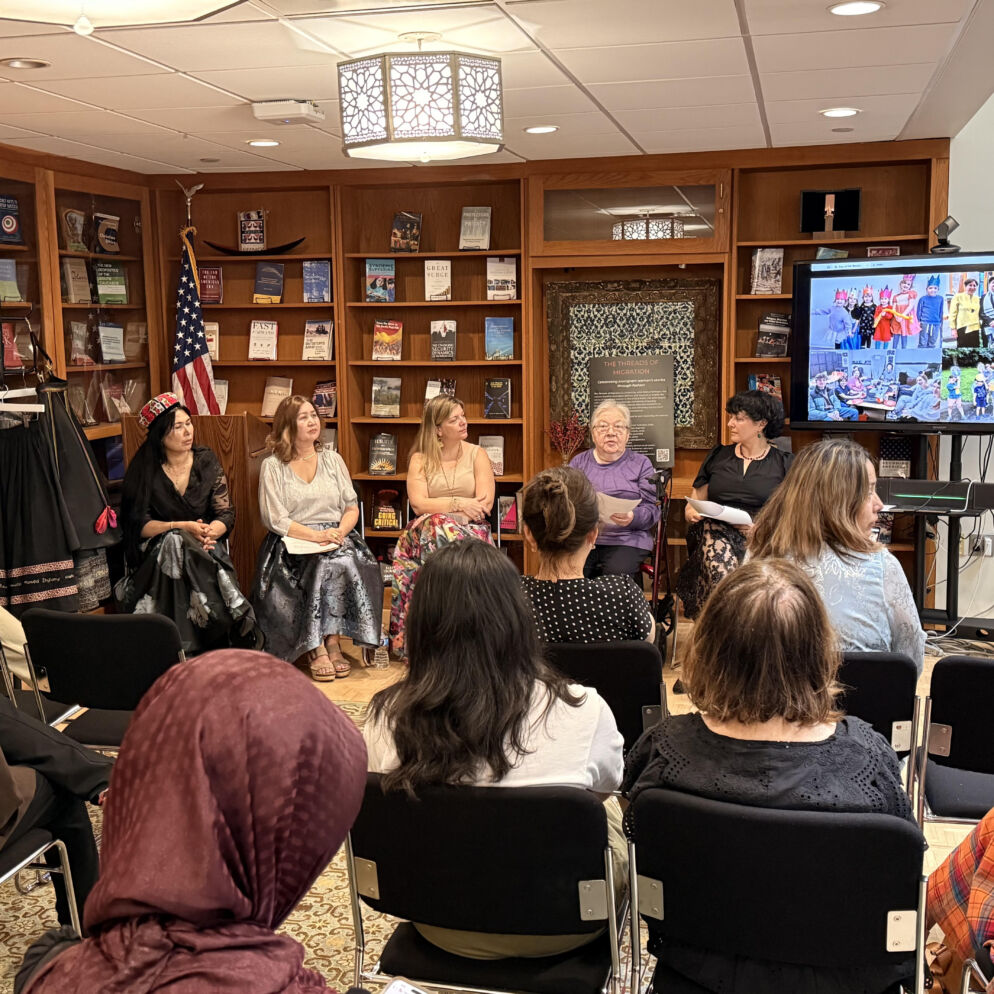
“The Threads of Migration” has been shown at Georgetown University, Windows on Wisconsin in Friendship Heights, and this past spring at fashion designer Diane von Furstenburg’s New York studio. Pomeranz continues to add heroes’ stories and the resulting skirts to the project. As the project is shown beyond Montgomery County, Pomeranz is adding immigrant women’s stories to represent the new locales she visits.
Another way she hopes to expand is by involving student journalists to conduct the interviews and fashion students to design the skirts.
“I never thought of myself as an artist,” Pomeranz says. “But I’m interested in immigrant stories. I’m interested in fashion and I would like to contribute to what’s going on with the immigration situation here.” With fabric, thread, and an astute journalist’s ear, inspiring stories of courage and perseverance have been sewn into the fabric of our community.
For more information on Mrs. Pomeranz, visit Made-to-measure dresses inspired by vintage styles. For more information and more stories of immigrant women’s resilience, visit “The Threads of Migration” Blog 1 — THE THREADS OF MIGRATION.
Lisa Traiger is an award-winning arts journalist who writes on theater, dance, music, film and visual arts from her home in Montgomery County.