
A missed name at a family gathering, a television turned up a little louder, frustration in restaurants where conversation feels harder to follow.
By the time many adults seek help, they have been compensating for years.
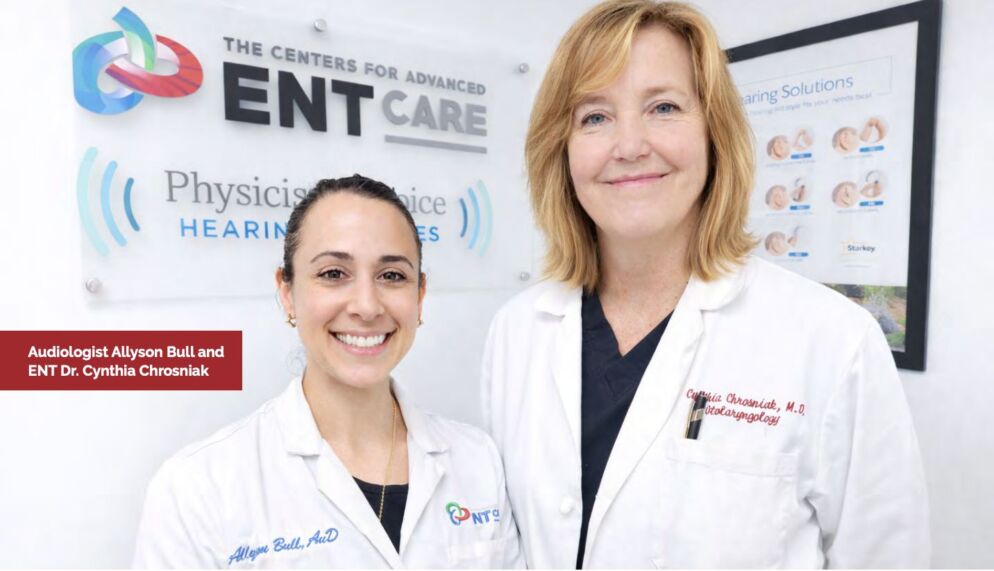
“I think the majority of the ages that we see are 40-plus,” said Dr. Cynthia Chrosniak, an Olney-based ear, nose and throat physician affiliated with MedStar Health. “By the time somebody recognizes they have hearing loss and the time they do something about it is usually about 10 years.”
Often, people simply do not realize how much they are missing.
“I’ll ask, ‘Are you here for hearing loss?’ and they’ll say, ‘I don’t think I have any hearing loss, but my daughters tell me that I do,’” Chrosniak said. “They might not realize their name was called twice already, but they only responded the third time.”
Another reason people delay testing, she said, is stigma.
“For some reason, people think of hearing aids as an old person thing. Even though everyone who needs glasses wears glasses, those who need hearing aids resist.”
One early clue is ringing in the ears, known as tinnitus.
“That typically coincides with the onset of hearing loss,” Chrosniak said.
Another common sign is difficulty understanding speech in noisy places — even when volume seems adequate.
“With age-related hearing loss, people tend to lose clarity of speech before they lose volume,” said Allyson Bull, an audiologist who practices with Chrosniak. “They’ll say, ‘I heard you, but I didn’t quite understand what you said.’”
Because volume is still present, many blame the speaker.
“People relate their hearing loss to somebody else’s fault,” Bull said. “They think, ‘You’re mumbling.’ They don’t recognize there’s hearing loss present.”
The most common causes in adults are age and noise exposure, Chrosniak said, with genetics also playing a role. Before assuming changes are simply aging, she recommends a medical evaluation.
“It’s important not to assume,” Bull added. “You need to know what kind of hearing loss it is and whether it’s appropriate to work with an ENT and an audiologist.”
The process begins with a medical history, including noise exposure, family history and medications that can affect hearing. The ears are examined for wax, eardrum scarring or other structural issues. Sometimes, Chrosniak said, the solution is as simple as a thorough ear cleaning.
Then the audiologist performs a comprehensive hearing test to measure hearing levels and speech understanding. From there, the team determines whether medical treatment, surgery or hearing technology is appropriate.
Hearing aids have changed dramatically over the past decade, becoming more discreet, sophisticated and intuitive.
“These are basically minicomputers,” Chrosniak said.
They are designed not only to amplify sound but to separate speech from background noise.
“Many years ago, hearing aids amplified speech and noise in the same manner,” Bull said. “They didn’t know the difference. Within the past 10 years, hearing aids are able to separate speech and noise. We can reduce the noise — not eliminate it — and enhance the integrity of the speech, making conversation easier.”
Bluetooth connectivity allows sound to stream directly from smartphones. Newer technology such as Auracast is expanding access in public venues, including theaters and stadiums, allowing users to connect directly to sound systems.
Despite the rise of over-the-counter hearing aids, both specialists urge caution.
“Buying over-the-counter hearing aids is like borrowing your friend’s glasses and expecting to see perfectly,” Chrosniak said. “They’re not programmable to your specific hearing loss.”
Bull noted that over-the-counter devices may help individuals with very mild loss and limited expectations, but personalized programming makes a significant difference for most patients.
“If programmed properly, patients shouldn’t have to do too much on their end,” Bull said. “The hearing aids should be more automatic. You shouldn’t have to constantly adjust them. They should just work.”
For individuals whose hearing loss is too severe to benefit from hearing aids, cochlear implants may be an option.
A cochlear implant is a surgically placed device that uses electrodes inserted into the cochlea to transmit sound signals directly to the auditory nerve. The technology is highly effective, Chrosniak said, but it is not identical to natural hearing. Patients require rehabilitation after surgery to learn how sounds are perceived through the device.
“It’s very helpful to keep somebody independent,” she said.
Untreated hearing loss can have broader effects.
“There is an indirect link between hearing loss and dementia,” Chrosniak said. “It’s not that everybody develops dementia if they have hearing loss. But if you have substantial hearing loss and you’re not using hearing aids, dementia tends to get worse.”
Struggling to follow conversation can lead people to disengage from family and social life.
Technology can help bridge gaps. Captioned phones, smartphone transcription services and direct audio streaming provide additional support.
“All of those are extra accessories to make accommodations and make life easier,” Bull said.
Cost remains a barrier for many families. Programmable hearing aids typically range from $2,000 to $6,000 per pair. Medicare does not cover hearing aids, though many private insurance plans offer benefits.
Hearing loss is common and treatable, and modern solutions are more discreet and more effective than ever. What often makes the biggest difference is not the technology itself, but the decision to address the problem early — before frustration replaces conversation and isolation replaces connection.
A simple evaluation can clarify what’s happening and open the door to options that keep people engaged in their families, workplaces and communities.
“It’s important not to ignore it,” Chrosniak said. “The sooner you understand what’s going on, the sooner you can do something about it.”