

Fawn Baranko became an interior designer and opened her own firm, Interiors by Fawn, after 20 years spent working as a Navy nurse. Interior design was originally a hobby, but she pursued a certificate from Montgomery College’s interior design program after retiring from the military.
In part due to her prior experience, Baranko believes that the environments a person spends the most time in can affect their mental health and well-being, and that includes the home.
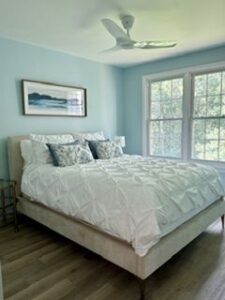
“Your home should work for you, not make your life harder,” Baranko says. “You should not be working to make your home livable. Your home should make itself livable for you.”
Her former life as a nurse is actually what led a couple in their 70s to contact Baranko about redesigning their Montgomery Village townhome. She managed the project and worked with other trade professionals while the couple were in another state, communicating through phone calls and videoconferencing.
“Their return home was like a HGTV show reveal,” Baranko adds.
Aging gracefully
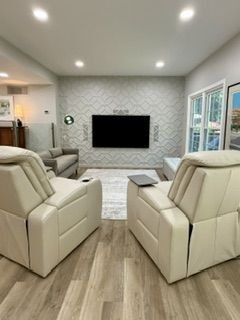
Because the homeowners are a couple in their 70s, Baranko designed their home to better accommodate their lifestyle. Many of the house’s accessibility features are nearly invisible, but add both form and function.
The bathroom shower was one such element. Baranko converted it into a no-threshold shower, which does not require stepping over a curb to enter and looks very sleek, as well as raising the ceiling to add more headroom.
“If you’re fighting against your home, you’re not going to be happy,” Baranko adds. “I don’t care how pretty it is. A big part of what I do in interior design is make sure that your house really works for you, as well as feels good to you.”
The comfort of the house’s human residents wasn’t Baranko’s only consideration. The redesign process involved making the home more pet-friendly. Pet-safe materials were used to create a safer and more comfortable environment for the homeowners’ cats and dogs.
Dressing room retreat
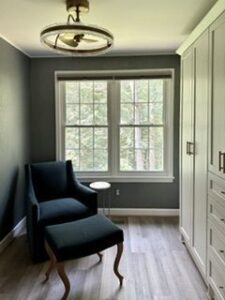
One of the homeowners wanted a space where she could store her clothing and other belongings away from her husband’s, so Baranko proposed converting an unused office into what she calls a “dressing room retreat” where she can relax or get dressed up. While this later became one of the client’s favorite rooms, she initially had to be convinced of its value.
“One of the challenges [with designing] is when you know something would be great for a client, but they’re not 100% there,” Baranko notes. She utilized some of the client’s favorite colors to transform the office into a space she compares to a jewelry box.
Making sure that the dressing room would be tailored to the client required Baranko to put herself in her client’s shoes.

“I literally sat in the chair, pretending that I was having a cup of tea,” she recalls. “I placed the mirror so she would have a view of the outdoors while sitting there. It’s all about figuring out what [the client] really wants by living in the space.”