When RG Steinman bought her home in 1989, she planted a Silver Maple, a tree she knew would grow to fit the shaded wooded landscape of Woodside Park, a walkable 1920s subdivision with deep front and back yards near downtown Silver Spring. “I just had a few plants and a big vegetable garden,” she says.
Steinman saw more potential for her land once she met and later married John Parrish in the mid-1990s. “We decided to turn the whole thing into a forest and meadow,” she says. Parrish, a botanist, and then employed by the State of Maryland Natural Heritage Program, shared her passion for the natural world. Together they began a decades-long restoration project. “If you leave the land alone around here, everything wants to revert back to forest,” he says.
And grow it did, with intention and management, the couple says.
173 Native Species, a Single Yard
From the front porch the view is a tiny urban forest with Red Hickory, Hazelnut, Sweetbay Magnolia, Persimmon, Red Cedar and American Holly, among others.
“My [yard] spreadsheet incudes 173 species native to Maryland,” Parrish says. On that list are 49 woody plants, 19 trees, 25 shrubs and five vines, with the rest a mix of annual and perennial herbs, goldenrods and eupatorium like Joe Pye.
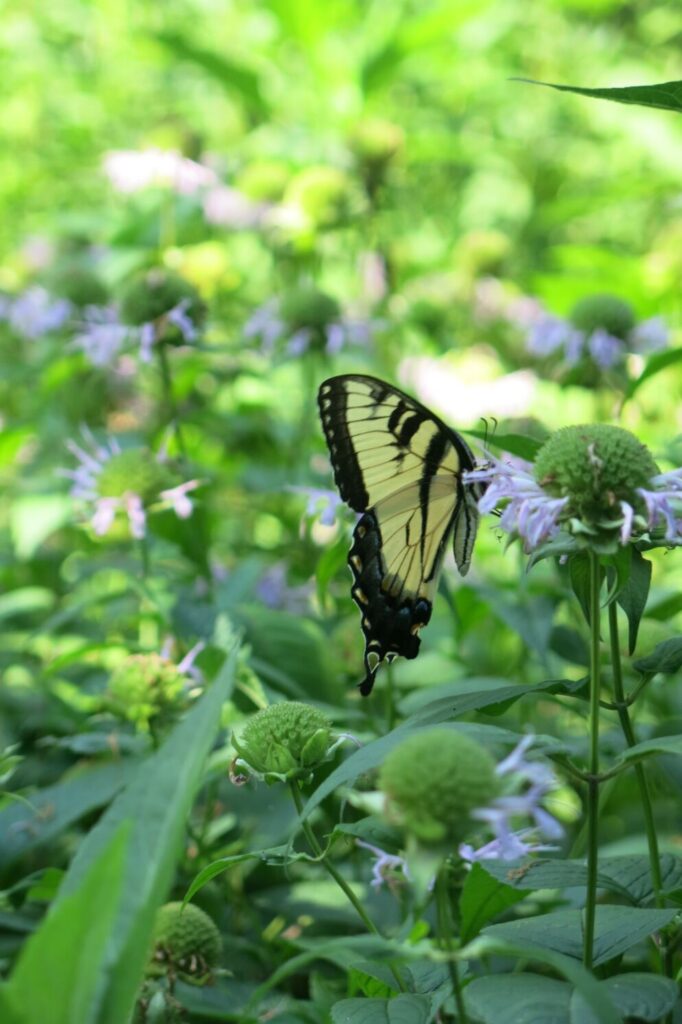
“These plants are highly important for bees, butterflies and other insects,” he says. “We also grow many species that serve as host plants for butterfly and moth caterpillars such as papaw, hickory, asters and milkweeds,” Parrish adds.
As a sign for walkers-by points out, the yard is recognized as a certified wildlife habitat by the National Wildlife Federation. Parrish says it’s common to see racoons, fox, deer and nesting birds who like the dense thickets, and was thrilled when a Brown Thrasher, a migrating bird not typically found in suburban areas, showed up. “It spent the whole spring and summer in our yard,” he says.
“This doesn’t happen on its own,” says Steinman, a former Government Accountability Office economist. “My day job now is keeping up with two gardens and native plant restoration as well as working to save the last remaining natural areas in Montgomery County,” she says. In practical terms that means controlling aggressive natives like Tell White Aster and removing non-native invasives such as English ivy and Japanese stiltgrass that can quickly out-compete the natives.
Engaged Activists Lead by Example, Others Follow
While Steinman and Parrish were certainly the first on their block to rewild their land, they are no longer the only ones to take such steps. Tall grasses on one lawn explain participation in No Mow May, a statewide effort to help the threatened bee population.
Other homeowners have carved out large patches from formerly tidy grassy areas to make way for native pollinator plants, flowers and vegetables.
“From our perspective, the community for us is the entire community, the humans, the plants and the other animals,” Steinman says. “And, so what we are doing is keeping this tattered web a little bit more alive and hoping to reweave it in this place.”
Steinman and Parrish, committed to this work as engaged civic activists, speak at community forums and testify before county boards in response to environmental threats.
Parrish is a former vice president of the Maryland Native Plant Society and current board member (with Steinman) of the Friends of Ten Mile Creek and Little Seneca Reservoir, and responsible for the watershed inventory that documented 450 native plant species, accounting for one-third of the native plants in Montgomery County. Together the couple also inventoried all the street trees for the more than 600 properties in Woodside Park.
Turning Degraded Land Into a Native Sanctuary
In their work to expand and protect forested areas in Montgomery County, Steinman and Parrish joined with friends Danila Sheveiko and Linda Schade to restore their 1.5-acre Kensington Heights property, purchased in 2015.
The two couples shared similar ecological ideologies.
Schade, a former Green Party candidate for the Maryland General Assembly, has a master’s degree in urban and regional planning from Cornell and a second master’s in Environment Management from the Yale School of Forestry. Both work in her favor as a consultant and civic activist with a focus on the environment.
Sheveiko, an IT contractor and Russian Ukrainian immigrant, is the son of a coral reef biologist who promoted ecosystem conservation in transboundary waters, led campaigns to save tigers and leopards and developed sustainable forestry policies. Continuing this legacy in Maryland, Sheveiko chaired the Montgomery County Water Quality Advisory Group, appointed by former County Executive Ike Leggett. Sheveiko also served as president of the Kensington Heights Civic Association and several terms as secretary and vice president of Civic Federation, an umbrella group of civic associations that engages elected officials on a wide range of issues.
Both Sheveiko and Schade were disturbed by the green space disappearing in North Kensington Heights. “Fifteen acres was lost [to development] in less than a decade from this [Kensington Heights] neighborhood, along with the forest and green space,” Sheveiko says. “To make a long story short, we beat out a developer who was going to turn [our land] into a cul-de-sac with McMansions, with every tree gone.”
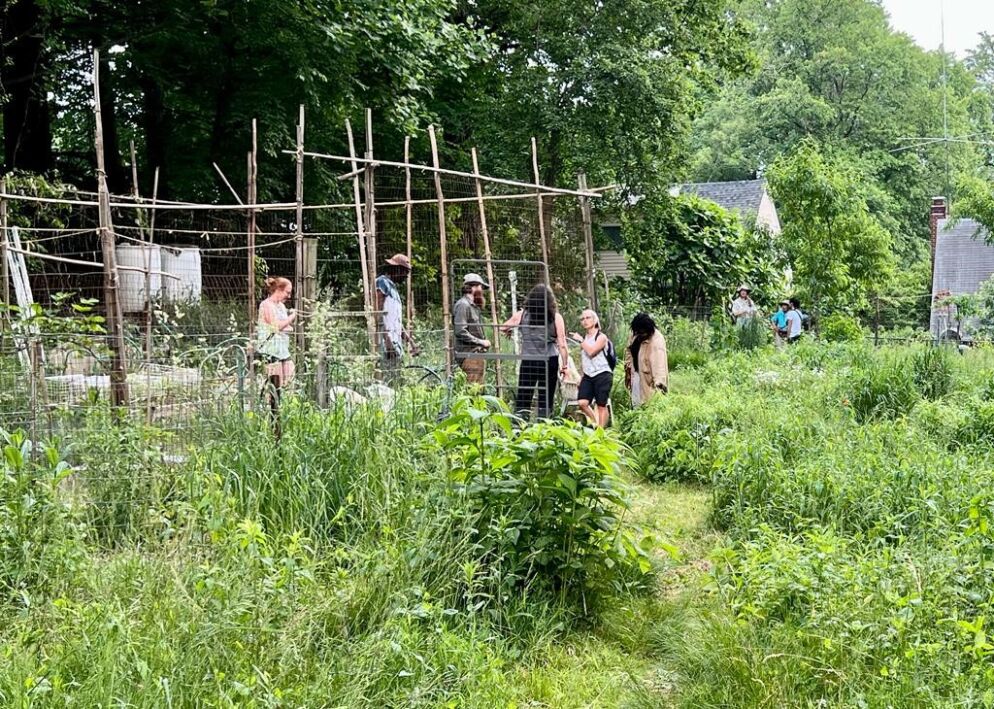
Their new home was an abandoned Azalea nursery covered with rusted metal and yards of twisted wire fencing. All was entangled with invasive plants like Mile-a-Minute, Japanese stiltgrass, celandine and entrenched by honeysuckle and porcelain berry vine. From the start, their intention was to turn it into a natural habitat. Guided by Steinman and Parrish, and years of painstaking manual labor, a garden, meadow and forest began to emerge from the damaged land.
Regeneration
“It took us three years to get rid of garlic mustard, and then after that another two or three years for stuff to even grow in places,” Sheveiko says.
Steinman and Parrish brought in hundreds of plants and seeds from their yard, and regeneration took place. “At this point we know of no other park in Montgomery County that has all native groundcover, the density, like we do here,” Sheveiko says. “We’re letting the natives be native, do their thing.”
Sanctuary as Urban Farm Educates
They call their experiment Sanctuary, which, three years ago was granted a special agricultural tax status as an Urban Farm, one of only two such farms in the county. In order to be in compliance, the operation must be located near a metro station, till at least one-half acre and sell or donate $5,000 worth of produce a year.
“We feel passionate about being a source for plants, and also about being a demonstrate site to educate,” Schade says. “Most kids growing up in Montgomery County have never seen a strawberry or a potato plant,” Sheveiko adds. “And so, the connection to the land is our primary objective,” he says.
Sanctuary welcomes schools, church groups and nonprofits to share the delights of the hidden mysteries along its trails, the ripe mulberries that fall from the trees and the flash of fireflies that dot the evening sky in early summer. Sheveiko sees their efforts as recolonizing the land. “We’re restoring ecological integrity,” he says. “I think the vision is to engage people in a dialogue, [to] revisit the ideal of what we want our homes to look like and [promote] the vibrancy of life we cherish,” Schade adds.
Their hope, Schade says, is to position Sanctuary as part of a growing wildlife network, where neighbors joining neighbors can work to create green corridors where animals, plants and people can flourish on the same turf. “We are thinking about habitat, about biodiversity, about hydrology, about pollinators, and when we get these [things] right, we have forests, and meadows,” she says.