Five years ago, one of Montgomery County’s crown jewels — the National Philharmonic — found itself in dire straits. Started in 1983 by Maestro Piotr Gajewski, a Polish émigré who served a four-year term on the Rockville City Council between 2007-11, the acclaimed orchestra was on the brink of shutting down. In the summer of 2019, in its 36th year, the NatPhil — as its musicians and friends call it — faced mounting debt of more than $150,000.
It took a bout of serious fundraising and a reorganization to reset the venerable group of world-class musicians who are in residence at the Music Center at Strathmore in North Bethesda.
Gajewski stepped down and Jim Kelly, a violist with the NatPhil for more than eight years, took the reigns as president/CEO during the 2019 crisis. He recalled facing a complete shutdown, but says, “We made major significant improvements in our artistic product, taking steps to represent our community better on stage.”
This included leaning into audience engagement, fundraising and updating the repertory, while maintaining a classical focus. This was key in a region with multiple professional orchestras ranging from the renowned National Symphony and Baltimore Symphony orchestras to the Kennedy Center’s in-house Opera House orchestra and independent symphonies in Fairfax, Arlington and other locales around the Beltway.
An extended live performance pause during the peak of the COVID pandemic didn’t help.
“COVID was really, really challenging,” Kelly says, “but it was actually a blessing initially. We were able to disrupt some things and make improvements as the business model changed to something very virtual. We thrived during that environment, but we’re facing another pivotal moment for the organization facing donor fatigue and fundraising challenges. We are very lucky to be in Montgomery County and are grateful to the Arts and Humanities Council and the Maryland State Arts Council.” Simply put, without major support from these agencies, Kelly notes, “We would not be able to exist.”
Nor would the group have made it to the 2024-25 season to celebrate its 40th year without local, state and private funding and support.
Representation Matters
But as the orchestra moves into its fourth decade, it is far different in many ways from its early years spent focusing on Bach, Beethoven, Mozart and the expected classical repertory applauded for centuries in concert halls around the world. Thirty-two core tenured members compose the orchestra, while substitutes and freelancer musicians are hired as necessary depending on the planned repertoire.
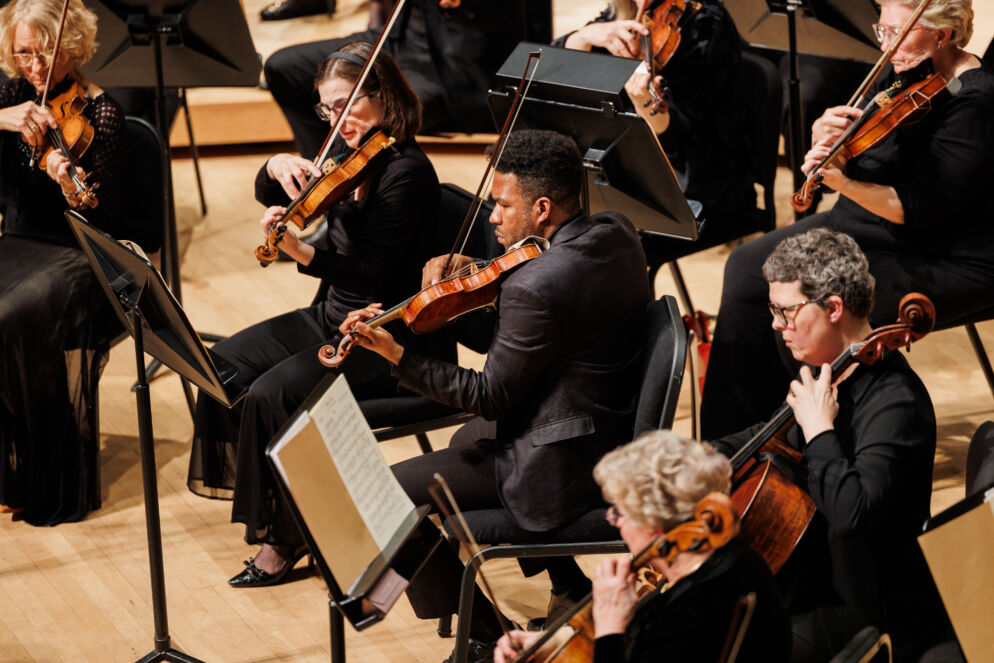
Silver Spring’s Amyr Joyner just began his second season, is a core violinist with NatPhil, and aside from looking forward to the all-Rachmaninoff celebration that kicked off the season in September, he appreciates the recent artistic focus on championing both new compositions and programming diverse composers and conductors. As a Black classical violinist playing in a predominantly white field, representation, says Joyner, matters.
Like the majority of orchestra members, Joyner plays with multiple ensembles in the region and also teaches college students at Howard University and youths privately. He received his doctorate in violin performance at the University of Maryland’s renowned School of Music in College Park.
“What struck me about NatPhil was the repertoire,” he explains. “The orchestra champions works … to represent the diversity that not only is in the Maryland, D.C., Virginia area, but also is indicative of the diversity of the country too.”
That includes works by Black composers, women composers and Latinx composers. Additionally, it also means bringing in guest artists, conductors and repertoire advisors to expand the classical canon and demonstrate what a diverse 21st-century orchestra looks like.
“As a Black musician in classical music, that has been something that I’ve been heavily involved in,” Joyner says. “I actually did my dissertation on Black composers of the violin…. So, I do appreciate that what we play is interesting and innovative.” As for working in a still very white-, male-dominated field, the violinist adds, “Things are slowly changing; I think we still have a ways to go,” toward diversifying professional classical music both on stage and in academia.
Takoma Park-based violinist Laura Colgate began subbing for NatPhil a decade ago, while working on her Ph.D., also at UMCP. In 2019, the concert master position opened up. But by the time Colgate auditioned and was hired in the re-named position of concert leader, the orchestra was in the midst of the COVID online season.
Raised in Memphis and initially taught to play by her music teacher mom, Colgate was attracted to the energy and joy the NatPhil musicians exude when they play together.
“A lot of times when you play with professional orchestras, [the musicians] have been doing that for so long, day in and day out, that they’re not excited by it anymore,” she notes. “Sometimes they’re actually cynical or miserable doing what they do. As an artist, as a musician, I never want to get to that point. I want to always be inspired and to discover something new.”

“National Phil definitely has a different energy [than many orchestras],” she continues. “I think it’s because we’re not a full-time orchestra. We don’t have a concert every single week, so we feel fresh when we play. You get to see everybody and you’re excited to play the music. The level is still so high, especially because we’re surrounded by so many great musicians and orchestras in this area.”
Colgate also loves the varied repertoire, particularly when work by women classical composers is scheduled; she wrote her dissertation on little-known women classical composers.
She adds, “I’m really excited about our final concert of the season in April [2025]. We’ll play an overture by Ethel Smith, an English composer who was really involved in the suffragette movement and a really amazing conductor/composer.”
“The second piece,” she continues, “is called ‘Montgomery Variations’ by Margaret Bonds. She was a composer during the Chicago Renaissance, who was also a really fine pianist. I’ve only heard it played by student orchestras … so I’m super excited to play it with a high-level orchestra. It’s a longer piece so that’s really exciting. The final piece on that concert is Shostakovich’s ‘Symphony No. 5.’ It’s going to be a really fun concert.”

All Kids. All Free.
Beyond National Philharmonic’s season at Strathmore — praised as one of the top acoustic concert halls on the East Coast — one lesser-known program that the orchestra prides itself on is its long-term focus on engaging with children and young adults to encourage next-generation classical music connoisseurs.
To that end, all children ages 7 to 17 are free at every NatPhil concert. While youngsters must be accompanied by an adult, Montgomery County high school students with a valid ID card can attend on their own. CEO Jim Kelly estimates that more than 12,000 children and teens have attended concerts on the All Kids. All Free program.
Beyond that, NatPhil has long committed to introducing every second grader in Montgomery County Public Schools to classical music in the concert hall. Each fall, the orchestra invites the county’s 10,000 second graders to Strathmore. In recent years, Richmond-based conductor Naima Burrs plans and directs these eight concerts held each November.
“I truly love this partnership,” Kelly says. “We get to work all year ‘round with MCPS making sure that our concerts are integrated with the curriculum. It’s not just about kids attending a concert for the first time. It’s uniquely designed with MCPS and their fine arts department, in conjunction with Strathmore and NatPhil. We work together every year … to center racial diversity and music diversity on the stage. We talk about musical components like layering, rhythm, harmony.”
He adds, “That experience compounded with what they learn in the classroom makes for such a special time.”
Additionally, NatPhil’s education programs include its long-running Summer String Institute, which selects 50 talented local teenaged string players to study intensively with the NatPhil’s top string musicians and other guest faculty. Joyner participated in the Youth Mentorship Program for talented students in Montgomery and Prince George’s counties this past season.
“I had two students this [past] year who I taught mostly online. It’s important to pass the torch along,” he says, adding, “Just having the [example] of Black classical musicians is very important to continue to push forward, because when people see that, they see the possibilities and their own potential.”
What’s Next for NatPhil
Kelly, who splits his time between his job directing and performing with NatPhil and various other locally-based groups and serving as a co-owner of Potter Violins, the specialty retail and repair shop in Takoma Park, is excited to celebrate the orchestra’s 40 years (plus one, accounting for the COVID closure). He anticipates this season as both on-message with its balance of classical and contemporary programming, and as a time to thoughtfully consider and plan for the organization’s future.
While National Philharmonic is one of the largest of the part-time orchestras in the region, it runs on a slim $2 million annual budget. In more flush years prior to the 2019 reorganization and subsequent pandemic, that budget was about $3.5 million.
“Our musicians are of the highest caliber,” Kelly notes. “They often play with the top-tier, major full-time orchestras. But they also spend a lot of time teaching, whether at the college level or privately for students from beginners through high school and college age.”
And, like Kelly, the NatPhil musicians hold multiple positions and are often entrepreneurial. “Many have their own businesses in music; some have businesses outside the music business—one of our musicians runs a successful mobile grooming unit but still practices very hard to play with us,” he says.
Kelly is looking ahead to deepening collaborations with like-minded musical organizations. He points to Verdi’s Requiem, scheduled for November, in a shared program with Cantate, a Montgomery County chamber chorus. He is also pleased to welcome back renowned pianist and Silver Spring resident Brian Ganz to the Strathmore stage on Feb. 28. Beginning in 2011, Ganz has partnered with NatPhil to perform the complete works of Frédéric Chopin at the Music Center at Strathmore.
But even as the 2024-25 season moves into full swing, Kelly is looking ahead to the National Philharmonic’s next five years, and beyond to its next 40.
“Right now, we are figuring out what the future of NatPhil is,” he says. “We were contracting a bit with the amount of concerts to ensure that we can sustain growth for the future. We have an opportunity to really change what our organization has been doing for 40 years so we want to thoughtfully make sure that we put plans in place, have those conversations and make sure that our budget is balanced.”
“Everybody’s life is busy, but a lot of people are putting a lot of hard work on that stage,” Kelly concludes. “We hope that Montgomery County will continue to support the arts by showing up and attending concerts. Music is for everybody.”
For further information on the National Philharmonic and its schedule of performances, visit nationalphilharmonic.org.