
 Housing stock across Montgomery County heavily favors tradition. The center-hall, two-story colonial symmetrically laid out reigns alongside the cozier Cape Cod, with its steeply pitched roof and pop-out dormer windows.
Outliers include mid-century modern gems. Influenced by modernist Frank Lloyd Wright, New York-born architect Charles M. Goodman brought prized mid-century modern homes to Montgomery County and nearby jurisdictions in the 1940s and ’50s. This year marks the 75th anniversary of these unique and stylish Goodman homes in the county. To celebrate in the coming months a series of activities from educational panels and lectures on the Goodman oeuvre, to walking and house tours of two key enclaves in Wheaton are planned. Additionally, art-making workshops where participants design their own miniature Goodman-inspired abodes will take place, one for families and one for more serious art-makers. And what would a 75-year-anniversary be without a 1950s-inspired sock hop featuring the Rock-A-Sonics, the Rockville-based rockabilly and rock ’n roll band.
What makes a Goodman home?
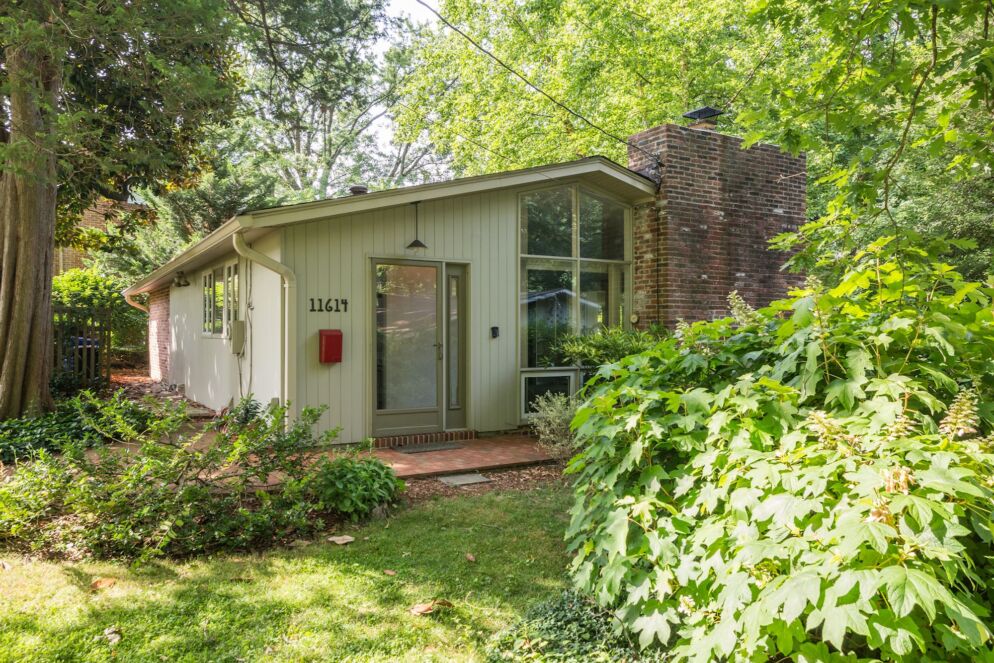
“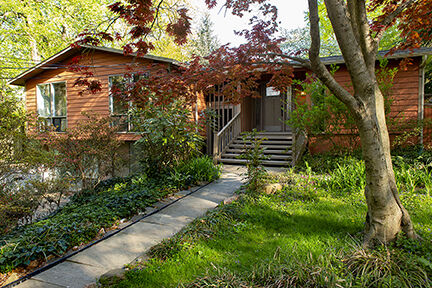 They’re very unique in the area,” noted Jim Epstein, president of Glenmont Forest Neighbor Civic Association, and a Glenmont Forest resident for more than 25 years. “These homes are really cool, because they sit catty-corner on the lot. They have an all-glass front with an architectural fireplace in the front, and they incorporate nature into the design.” He also pointed out that these well-designed, mid-century modern homes were intentionally affordable for the many young couples and families who found themselves in the region during the post-World War II federal government boom.
Accordingto Montgomery Planning, approximately 275 single-family Goodman homes have been documented in the county, primarily in Silver Spring and Wheaton, including in Hammond Hill, Wheatoncrest, Takoma Avenue and Rock Creek Woods subdivisions. They were all developed in the 1950s. In Potomac there’s Hollinridge and in Hillandale, Crest Park, which are both about a decade younger.
Hammond Wood is listed on the National Register of Historic Places. This prestigious designation honors the distinctive modernist design ideals that Goodman promulgated, along with his commitment to building community-centered locales. The architect also contributed to commercial and government projects that articulate his ideals as a mid-century modernist. He provided initial designs for Washington National Airport and served as head architect at the Treasury Department and at the Air Transport Command.
For Pam Schaeffer, a real estate agent with the Erich Cabe team at Compass, her Goodman home was love at first site. “I was looking at these huge floor-to-ceiling windows that were everywhere. And the high ceilings, so even though it’s a small place, it feels spacious,” she said. Unique to Goodman neighborhoods is how the houses are not set in linear rows along parallel and perpendicular streets like typical suburbs in the region.
“Goodman homes are sited on different angles on the street,” Schaeffer said, adding, “I later found out that that was because he built these homes so everybody could have a Western view, a sunset view from their main living [room] space. It’s actually better in the winter … in the summer, when the leaves come in, the view is full of trees. My whole living room is golden when the sun sets, which is amazing.”
It’s been nine years since Schaeffer moved from her home in Bannockburn to Hammond Wood. These homes have a much smaller footprint than most new single-family homes in the county. Many measured about 1,100 to 1,400 square feet, unless owners have put in additions; the smallest model was – and remains – 866 square feet. “I just wanted a house I could wrap my arms around,” Schaeffer said.
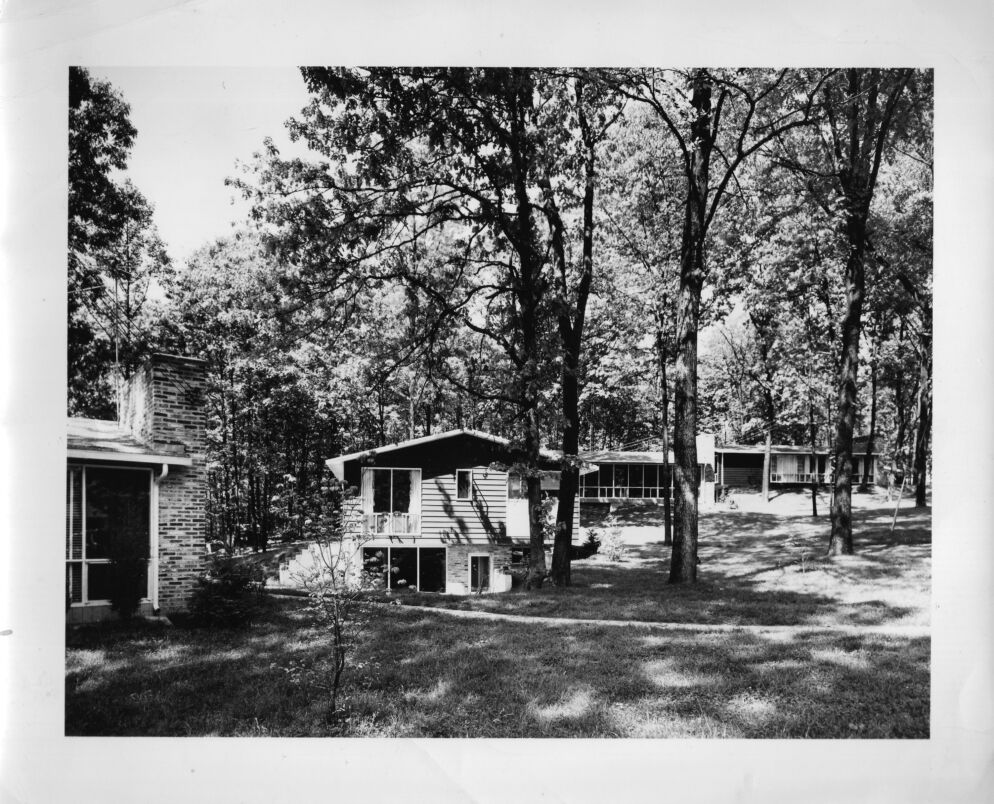
The heyday of mid-century modern design, from residential housing to commercial and government buildings, along with furnishings, accessories and even fashion, lasted from the mid-1940s through about 1970. This unique design period was characterized by clean, simple lines and planes. That often meant flat roofs and low-lying horizontal structures with roof overhangs, as well as orienting houses to take advantage of the sun, shade and cross-ventilation. Another key concept, which Goodman excelled at, was situating buildings in nature and preserving the natural landscape, particularly during a period when builders would clear large swaths of acreage of all trees and vegetation to create endless subdivisions.
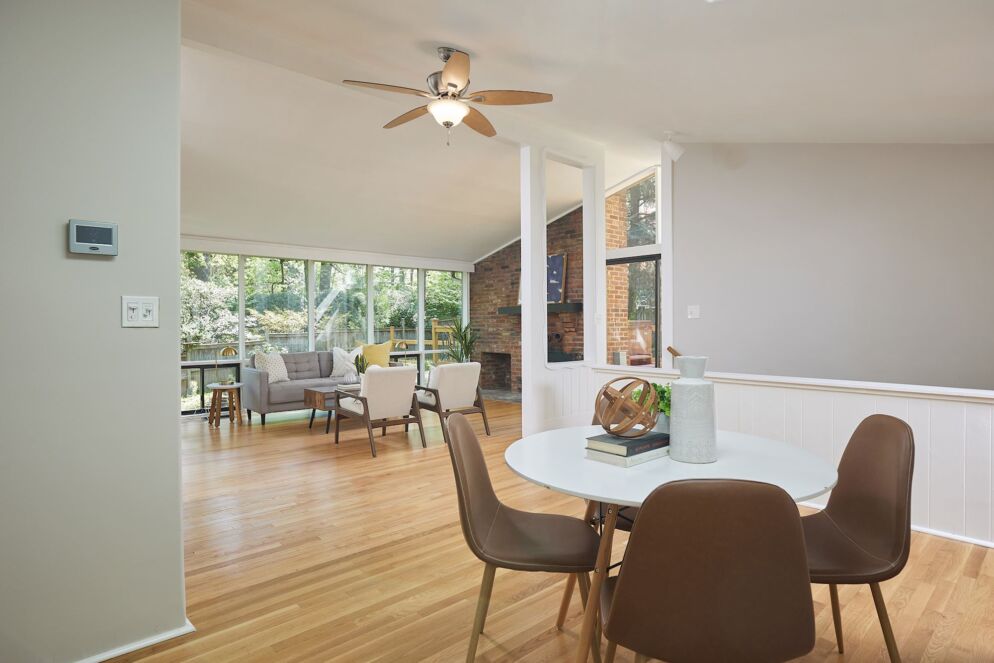
Goodman homes showcase other mid-century modern principles that are again popular in the 21st century, including open-plan common living spaces, spare use of ornamentation and attention to the environment in landscaping and siting homes. Yet, unlike today’s new homes, mid-century moderns, including Goodmans, kept private spaces like bedrooms and bathrooms small and efficient, rather than the lavish retreat-like master bedroom suites common today.
As the county Goodman homes turn 75, few original owners remain. But what endures, according to Schaeffer, is the friendliness and communal sensibility of Goodman homeowners. Warm weather brings regular potlucks. Year-round, neighbors check on elderly homeowners and call about a dog who inadvertently gets loose on the street. “I’ve lived in a lot of places,” she said, “the community here is very special. It’s very eclectic … and an example of a community that’s truly diverse. We have a listserv just for the 58 people who live in the 58 houses here in Hammond Wood, plus the people who lived here before, because … we want to keep up with them, too.”
Epstein, who has helped organize and fundraise for the 75th celebration events, noted, “When you talk to a Goodman owner, they’re really all about their neighbors. They communicate together and do events together,” including many components of this anniversary year.
Why celebrate Goodman homes?
For Epstein, Goodman contributed important ideals and aesthetics to the built landscape of Montgomery County. Equally relevant in our current era, Goodman “wanted to create these mid-century modern homes that were accessible and affordable, yet modern,” he said.
“Why should we celebrate that? Because these homes are part of our community,” Epstein said. “And because we want to create and build on the sense of community he gave us. The people that I’ve talked to who live in Goodman homes or in the Goodman clusters are really proud of the history, and they really create a community feel. We want to generate even more community cohesion” with these events.
Schaeffer hopes that through the planned activities more neighbors will learn about and understand the importance of Goodman’s contribution to the mid-century development of the county. She added, “I want the original designs to be maintained.” This is particularly so in a county where homebuyers often purchase a small, older home only to tear it down or gut it to build much larger houses – the McMansion phenomenon.
“We’ve been very lucky: Nobody has violated that,” Schaeffer said. “I would like that to be maintained because these homes are beautiful, interesting and unique…. Also notable about Charles Goodman is that, as much as possible, he used recycled materials, including bricks from a Baltimore warehouse” among other materials.
“I’m not an expert [in development],” Epstein added, “but I would say don’t create McMansions. Builders should go back to natural construction materials. Open up your houses to nature. Use glass. Use brick. Incorporate trees and nature into the design.”
Goodman did this 75 years ago. His legacy remains in the continued popularity and livability of his homes. Today’s planners and builders could learn from his example.
Goodman 75 will sponsor numerous activities in 2026, including house tours on Sept. 19 in Hammond Wood, panels on the architecture of Goodman Homes and on oral histories, a 1950s-style sock hop at the Wheaton American Legion Sept. 25, and art workshops with Marcie Wolf Hubbard at the Wheaton Recreation Center April 25 and Sept. 25.
Lisa Traiger writes from Wheaton, where she covers theater, dance, art and culture for local and national publications.