
Local Ballet Center Puts Its Students Center Stage
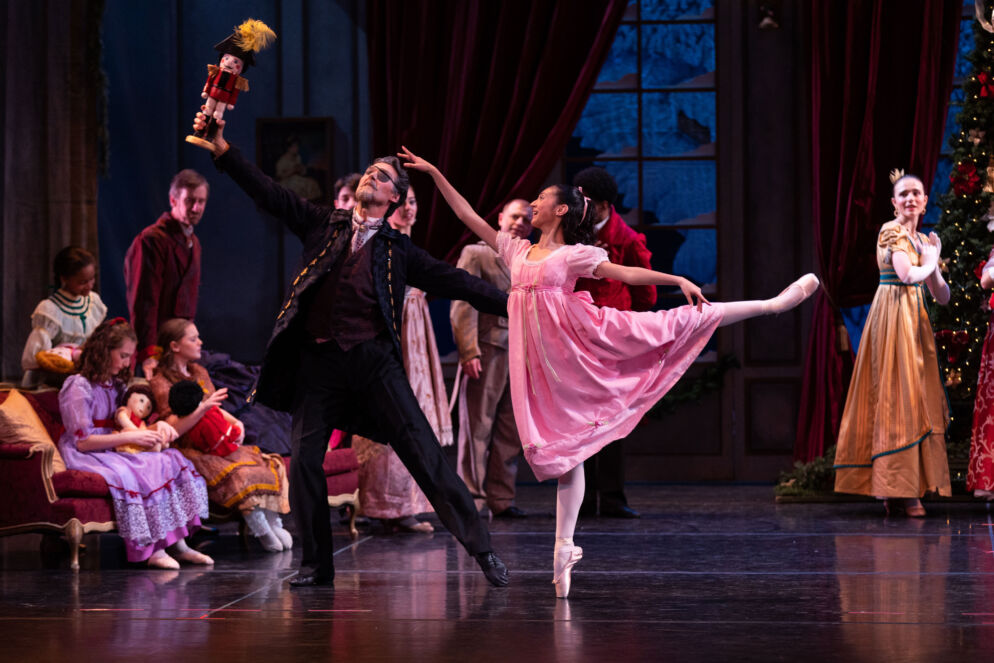
Well before August, when Christmas decorations show up at Costco, ballet school directors around the county are already deep into planning their biggest production of the year: the Christmastime ballet “The Nutcracker.”
Replete with an awe-inspiring growing Christmas tree, a Snow Queen in a white tutu and her Cavalier, dancing life-sized dolls, wooden soldiers battling vicious mice and a second act filled with dancing sweets, this ballet has been a winter holiday classic for more than six decades across the United States. In Montgomery County, like elsewhere throughout North America, December means “Nutcracker” time for ballet studios from Silver Spring to Rockville to Olney.
But why has “The Nutcracker,” a ballet first performed in Czarist Russia in 1892, become a Christmas ritual in the United States, akin to Nativity pageants or Handel’s “Messiah”? Throughout Europe “The Nutcracker” is presented year-round by professional ballet companies.
Former Washington Ballet dancer Frederick Wassmer, who has performed numerous roles in the ballet, including in recent years at Maryland Youth Ballet’s production in Rockville, says of the ballet’s enduring popularity, “Many of these iconic ballets, like ‘Nutcracker,’ have that iconic music by Tchaikovsky and that takes you into the joy and fantasy of the ballet. There’s this wonderful story and quality of escape from our world with a lot of beauty and magic.”
Christmas at the Ballet
The ballet’s connection to Christmas occurs in Act I, which occurs on Christmas Eve at a wealthy family’s holiday party. A sparkling tree dominates the background and gifting presents to the children is central to the action. Its popularity in American culture can be traced back to the late 1950s when CBS broadcast the New York City Ballet’s “Nutcracker” as holiday television fare.
Aside from enticing generations of girls who yearned to don frilly tutus and balance on their toes, the popularity of the televised version led to a rash of “Nutcrackers” in nearly every American city with a ballet studio. Since then, ballet studios and companies have come to rely on this annual production as integral to the budget for ballet is an expensive art form.
Founded in 1971 by Hortensia Fonseca after teaching ballet in her Kensington basement, Maryland Youth Ballet’s students initially performed a simpler ballet in December, Fonseca’s “The Enchanted Clock.” After retired National Ballet dancer Michelle Lees took over MYB’s direction, she choreographed the youth troupe’s first “Nutcracker” in 1990.
“It took nine months.” Lees says. “It was like giving birth and just as painful. I used toothpicks for the snowflakes to figure out some of the complicated crossings.” Interestingly, in the 1890s, Marius Petipa, the first “Nutcracker” choreographer, was also known to use small models to help him visualize and plan his dancers’ complicated floor patterns.
Nutcracker Transformations
At the core of any “Nutcracker” lies the magic of transformation: the simple story follows Clara, a pre-adolescent girl, at her family’s holiday party. There, her mysterious Uncle Drosselmeyer gifts her a magical toy nutcracker. She follows him into an enchanted nighttime dream world of sweets where toys and candies come to life and dance the night away.
Now in its 32nd year, this Silver Spring ballet center’s “Nutcracker” provides its students—the youngest, nine- and ten-year-olds; the oldest, high-school seniors — the opportunity to perform in a professional atmosphere. Additional cast members include parents and other adult ballet students, like Wassmer, who takes adult ballet classes at the studio, join the cast in some of the adult acting roles.
The Holiday Tradition
The production at the Robert E. Parilla Performing Arts Center at Montgomery College in Rockville attracts families with children, MYB alums, ballet lovers and those who find the ballet an annual holiday tradition, along with curious newcomers. Tickets often sell out, particularly for “The Mini-Nut,” an abbreviated version of the two-act ballet for the youngest audience members and their parents, including one sensory-friendly performance for audience members with special needs.
Deidre Byrne, an MYB alum who danced with the Cleveland San Jose Ballet for more than a decade, now serves as Maryland Youth Ballet’s artistic director and principal of the academy. Together with ballet teacher Kristin Brown-Maki, the two teach and rehearse the 110 to 120 dancers in the cast every weekend beginning in October. The youngest dancers play angels, mice and toy soldiers who come to life, while older girls and boys take roles as children in the Act I holiday party.

The most senior dancers, those who attend dance classes five or six days a week, take the lead ballerina roles in Act II, including the Snow Queen, Sugar Plum Fairy, Arabian, Spanish and other variations in the Kingdom of the Sweets section.

Students don’t audition; instead, even before school starts in September, they must commit to attending all rehearsals and performances. “We have a very high standard of ballet training here,” Byrne says. “The mission of this school is to give students the full professional training package, which includes professional-level performances,” of which “The Nutcracker” is a major highlight. “They have their training in the classroom,” she adds, “but they need to learn how to perform on the stage and engage with the audience—[gaining] that professional level of experience.”
From Mouse to Sugar Plum Fairy
Kensington’s Riley Horner, a 15-year-old sophomore at Einstein High School, has studied ballet for 12 years. He finds the “Nutcracker” experience special, from the weekend rehearsals to warming up backstage and performing multiple times in front of large audiences. This year, Horner’s roles include Snow Prince, partnering one of the older girls. “I’ve never partnered someone on stage yet, but I feel pretty good about it,” he notes. “I always make sure my partner is on balance, so I can’t be too far away or too close.”
Sikelia Pasquina, a 17-year-old senior at Bethesda Chevy Chase High School, began dance lessons at age 4. Now, she leaves school one class period early each day to make it to her advanced ballet classes at MYB. This is her third year dancing the coveted Sugar Plum Fairy role, which features the original 1892 choreography. “My first role [in ‘Nutcracker’] was as a mouse,” she recalls. “I wasn’t expecting that. When you start ballet, you dream of tutus and fairies and there I was in a gray body suit acting aggressive.”
“I honestly was not expecting to dance the Sugar Plum Fairy when I was just 15,” Pasquina says, when she learned Byrne selected her for the difficult role. “The whole MYB community is one of the most loving and supportive places to dance. Many people imagine the cut-throat world of ballet, but we all seriously love each other and cheer each other on.”
A one-time ballet mom, and lobbyist for a Fortune 500 company, MYB executive director Alyce Jenkins has seen her own daughter and hundreds of ballet students not only develop grace and strength, but also acquire life skills from their ballet classes.
“This training really applies anywhere in life,” Jenkins says, noting the discipline, camaraderie and ability to support others that the students learn. “Isn’t that important in any career, whether or not they become professional dancers?”
And while this annual production, is just one among a number of local Montgomery County “Nutcrackers,” MYB’s production runs like clockwork. Preparations begin as early as June and July, and the ballet remains a heavy lift for the nonprofit school. Even so, Jenkins says, “We would do it even if we lost money. It’s part of the training and, I think, some companies wouldn’t do it. But ‘Nutcracker’ is such a tradition for those who come see it and for those who dance it. It’s a truly meaningful part of what we do here.”
Local ‘Nutcrackers’ Galore
Maryland Youth Ballet: “The Mini-Nut” runs Dec. 7–8, 11 a.m., 1 p.m., 3 p.m., Cultural Arts Center Montgomery College, Silver Spring. Tickets $25.
Maryland Youth Ballet: full-length “Nutcracker” runs Dec. 20, 7 p.m., Dec. 21–23 and 26, 1:p.m. and 5 p.m., Robert E. Parilla Performing Arts Center, Rockville. Tickets $32. marylandyouthballet.org/tickets
Metropolitan Ballet Theatre: “Nutcracker Suite” (short version) and “The Nutcracker” (full-length) runs Dec. 7-15, 10:30 a.m., 1 p.m. and 4 p.m., Robert E. Parilla Performing Arts
Center, Rockville. Tickets $22-$30. mbtdance.org/nutcracker
Olney Ballet Theatre “Nutcracker” features costumes from The Washington Ballet’s Mary Day version and runs Dec. 19-24, 7 p.m., plus 1 p.m. Saturday and Sunday, Our Lady of Good Counsel Performing Arts Center, Olney. Tickets $35-$48. olneyballet.org/nutcracker
Akhmedova Ballet Academy “Nutcracker” runs Dec. 16, 3 p.m.
(mini-nut) and 7 p.m. Cultural Arts Center Montgomery College, Silver Spring. Tickets $10-$30. akhmedovaballet.org/showevents
Lisa Traiger grew up dancing parts in Waltz of the Flowers, Arabian and Mirlitons in “The Nutcracker” with the now-defunct Prince George’s Ballet in Maryland.